Choose an inference source
Decide between a hosted model, a model server you already operate, or a new deployment in your cloud.
The choice on Inference → New endpoint answers one question: who runs the model server? It does not decide which application may call it or whether it uses shared context.
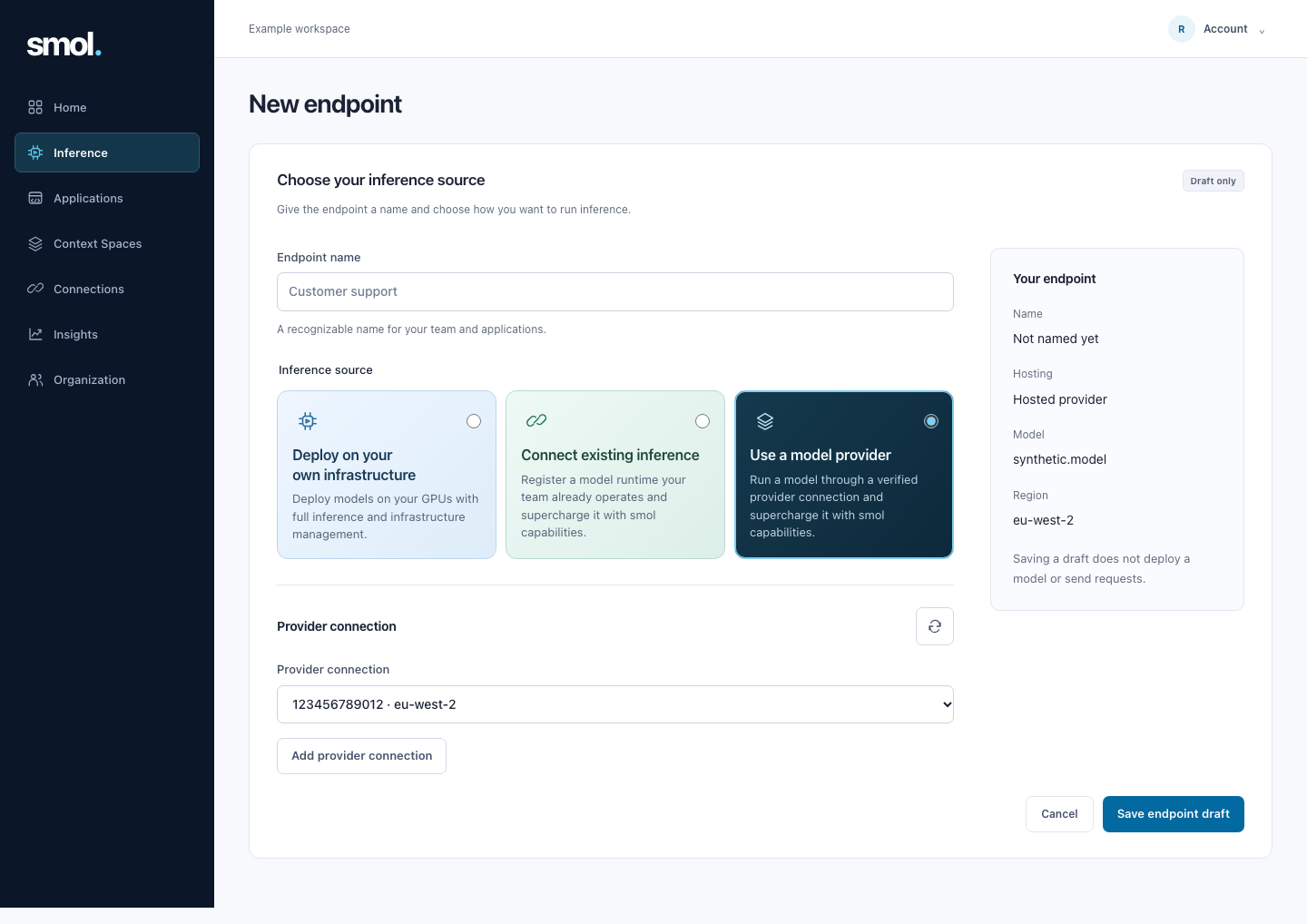
| Source in the console | What you bring | What Smol does | Who pays for serving? |
|---|---|---|---|
| Use a model provider | A verified provider connection, region and supported model | Connects the endpoint to a managed model API; no model installation | Your provider account is billed for billable requests |
| Deploy on your own infrastructure | A supported compute connection and placement in your cloud | Provisions new compute after approval and deploys a compatible model and serving stack | Your cloud account pays for the resources, including idle running compute |
| Connect existing inference | An already-running, compatible model server and its Smol gateway integration | Connects that serving target to an endpoint without provisioning another machine | You continue to operate and pay for your existing service |
For example: if your team already calls a Bedrock model, choose the provider path. If it has an AWS account but no server and wants Smol to run a supported open-weight model on a GPU there, choose deployment. If it already operates a compatible serving stack, choose existing inference—not a new EC2 deployment.
After setup
Section titled “After setup”Your backend calls the endpoint using a direct credential or an authorized Application. The public API isn’t a console login or an AWS access key. Add automatic context when you need it; use routing when the endpoint has more than one eligible target.
Next: hosted provider · deploy on EC2 · connect an existing model server.