Endpoint access and readiness
Separate serving health from caller permission and safely issue, rotate or revoke an endpoint credential.
A backend can call a ready endpoint without registering an Application. It still needs authorization. Three independent checks matter: the endpoint has a matching serving target; the caller has endpoint access; and that caller may use any context sent with the request.
Is the endpoint ready?
Section titled “Is the endpoint ready?”| What you see | What it tells you | Next action |
|---|---|---|
| Draft or incomplete setup | Configuration exists; model execution is not established | Open Overview and finish the source-specific setup |
| A target needs activation or verification | There is no confirmed ready target on this path | Activate a hosted endpoint, connect your server or finish the EC2 deployment |
| Health check due | The previous health observation has aged; this is different from revoked access or a failed verification | Refresh status or check the connection; eligible paths can recheck on demand |
| Verification failed or access expired | This target cannot be relied on to serve | Inspect the target’s status, correct or renew access as prompted, then check again |
| Ready for authorized requests | The serving path can accept an authorized request | Use Connect; a real response plus Activity confirms execution |
With more than one target, distinguish endpoint availability from the health of a specific target. An alternate only helps when the effective routing policy can use it.
Choose and manage the caller
Section titled “Choose and manage the caller”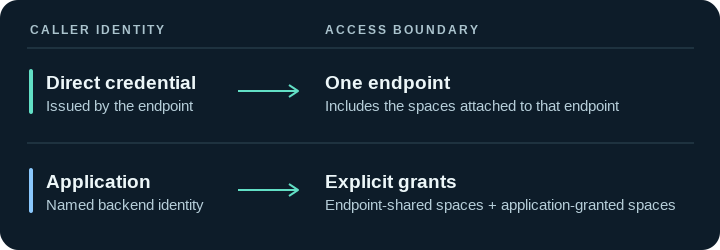
- Direct endpoint credential: Connect → Access credentials → Create credential. Give it a name (and optionally an expiry). Save the client ID and one-time secret server-side. A new credential includes inference access to all spaces attached to this endpoint, including those attached later. Attaching a space grants permission; it does not automatically include all its content.
- Registered Application: Grant the Application access to the endpoint. During inference there it may use spaces shared by the endpoint or spaces separately granted to the Application. Endpoint sharing does not grant the Application direct content access through the Context API. Its identity and grants remain independent of direct endpoint credentials.
- Rotate or revoke: use the credential row’s actions. When rotating, save the replacement secret immediately and update the backend. To remove access, choose Revoke for exactly the intended credential and confirm. If a secret is lost it cannot be read back from the list. Neither operation stops an instance or ends cloud charges.
Diagnose a rejected request
Section titled “Diagnose a rejected request”An invalid_identity response concerns the bearer token: check its expiry, client, environment and token exchange. execution_space_access_denied concerns authorization to the referenced space: confirm the caller, organization and grants; don’t rotate an otherwise working secret to fix a missing grant. If an outcome is ambiguous, inspect Activity, not a second generation. See authentication and error handling.